

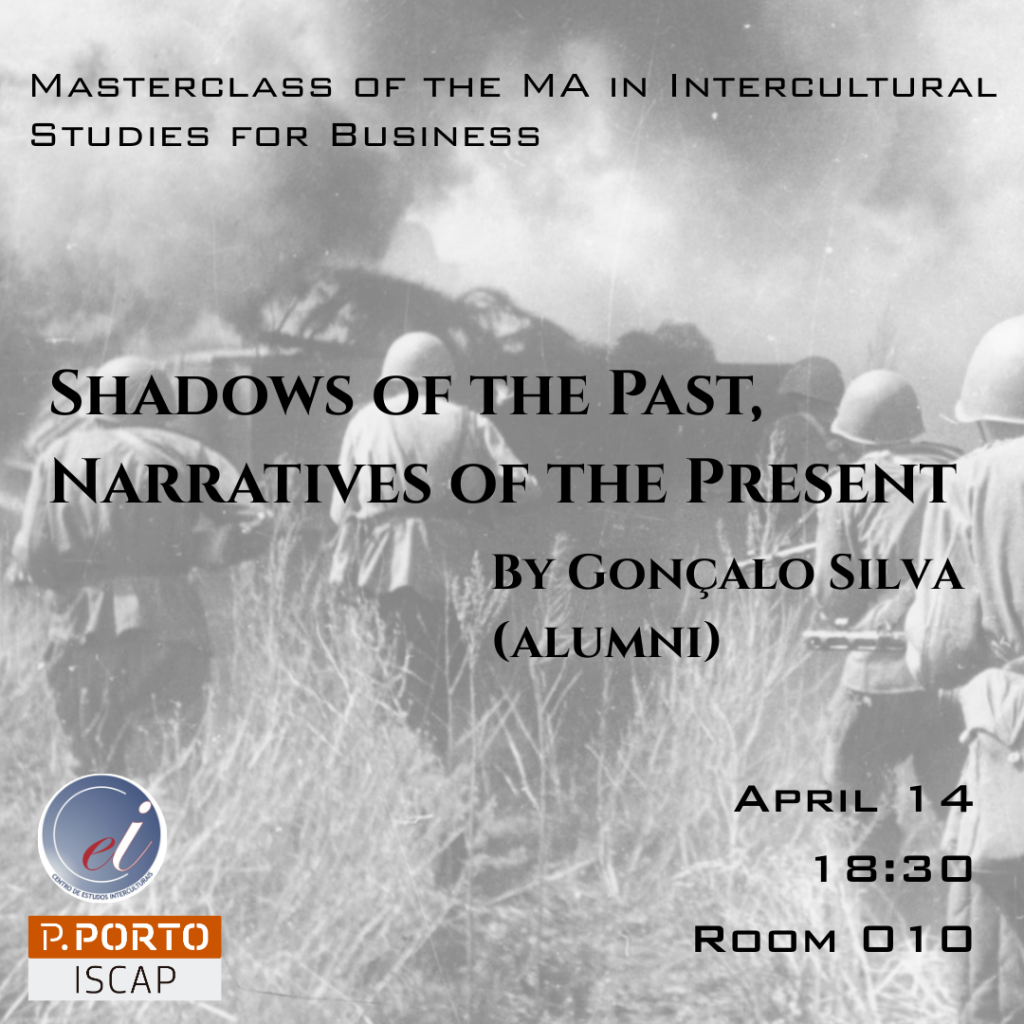
Next Tuesday, April 14, at 6:30 PM, the Masterclass of the Master’s in Intercultural Studies for Business, titled “Shadows of the Past, Narratives of the Present”, will take place in Room 010 at ISCAP–P.PORTO, delivered by alumnus Gonçalo Silva.
The Masterclass examines the evolving dynamics of collective memory surrounding the Second World War by linking the material transformation of war heritage with the ideological reconfiguration of historical narratives in contemporary culture. German bunkers and fortifications from the Second World War in France, Belgium, and Poland—such as Wolfsschanze, the Lorient U-Boat pens, and the Merville Battery—have shifted from strategic military infrastructures to heritage sites and tourist assets. This transition involves processes of preservation, interpretation, and ethical negotiation that reposition them as spaces for education, memory, and reflection. Beyond these physical remnants, the session critically explores the role of women in the rise and consolidation of the Third Reich, challenging their traditional portrayal as passive agents. Instead, it analyzes how hegemonic models of femininity—centered on motherhood, domesticity, and social reproduction—contributed to the regime’s ideological legitimation.
By connecting these historical perspectives with contemporary developments, the Masterclass also investigates how such narratives are reactivated and reshaped in digital environments, where they are often decontextualized, romanticized, or mobilized within revisionist and identity-driven discourses. Through this interdisciplinary approach—combining heritage studies, gender analysis, and digital media research—the session ultimately reflects on how the legacies of war, both material and symbolic, are continuously curated, contested, and transformed in the present.
Gonçalo Silva is a PhD student in Cultural Studies at the University of Aveiro, developing research at the intersection of memory, gender, and digital culture, with a particular focus on the reinterpretation of Third Reich narratives in contemporary digital environments. Holds a BA in Applied Languages (Business Relations, English and German) from the Faculty of Arts and Humanities of the University of Porto and a Master’s degree in Intercultural Studies for Business from ISCAP-Polytechnic of Porto. Research engages critically with questions of ideology, representation, and cultural memory, contributing to ongoing debates on the reconfiguration of historical narratives in the present. Currently works as a Senior Academic Services Officer at Fernando Pessoa University.