

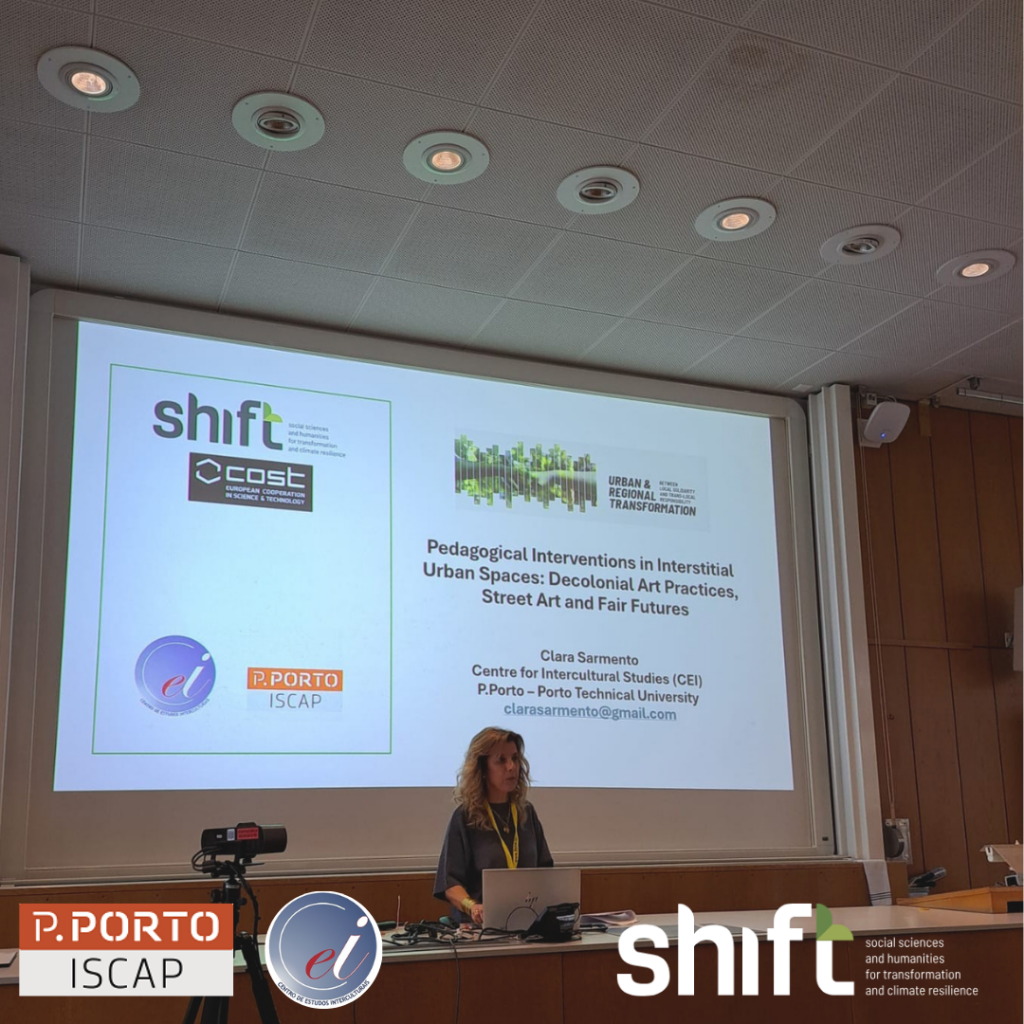
Clara Sarmento, Director of the Centre for Intercultural Studies (CEI) of ISCAP-P.PORTO, was invited to contribute to the final conference of SHiFT – Social Sciences and Humanities for Transformation and Climate Resilience (COST Action CA21166), entitled Urban & Regional Transformation Between Local Solidarity and Trans-Local Responsibility, held at the University of Basel, Switzerland, on 27–28 August 2026.
Her contribution, “Pedagogical Interventions in Interstitial Urban Spaces: Decolonial Art Practices, Street Art and Fair Futures,” presented a situated, practice-based pedagogical approach developed within the Master’s in Intercultural Studies at P.PORTO. The approach brings together decolonial theory, Indigenous research methodologies and urban street art to explore questions of climate justice, cultural memory and urban transformation.
Focusing particularly on peripheral and transitional areas of Porto, the pedagogical practice engages students with street art as a form of informal heritage, slow memory and situated critique. Through urban walks, collaborative visual mapping, photographic documentation and critical annotation, students investigate how artworks in public space can make visible experiences of gentrification, housing precarity, environmental injustice, migration and social exclusion.
The presentation proposed a conception of urban environments not as neutral backdrops, but as living archives of social-ecological struggle, memory and possibility. By positioning street art simultaneously as an object of study and a pedagogical medium, the approach seeks to foster epistemic justice, plural knowledge systems and more critical understandings of sustainability and urban regeneration.
These questions closely resonate with the broader concerns of the SHiFT COST Action, whose final conference brought together interdisciplinary perspectives on urban and regional transformation, climate resilience, local solidarity and trans-local responsibility. The conference addressed how locally grounded forms of knowledge, action and solidarity can contribute to wider transformations towards more sustainable, resilient and socially just futures.
The SHiFT Final Conference provided an important international forum for advancing these interdisciplinary conversations and for examining how creative and decolonial approaches can contribute to fairer, climate-resilient and more plural urban futures.