


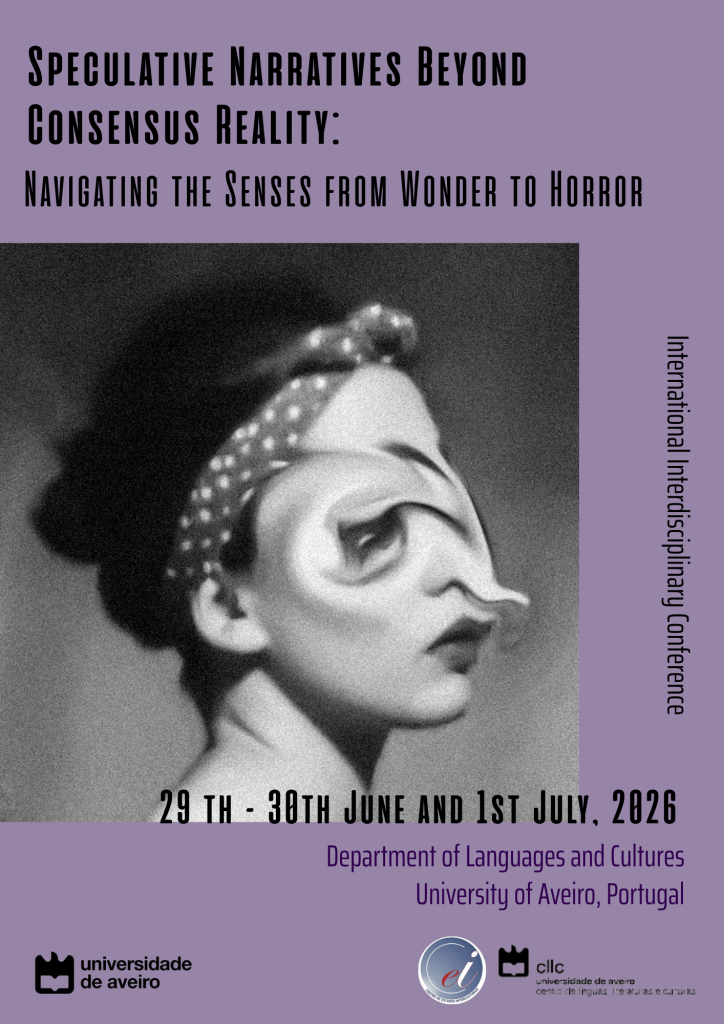
Venue: Department of Languages and Cultures, University of Aveiro, Portugal
Conference Organisers: Popular Culture Group
We invite scholars, researchers, and artists to submit abstracts for the upcoming academic conference, Speculative Narratives Beyond Consensus Reality: Navigating the Senses from Wonder to Horror. This event will explore the transformative potential of speculative narratives – across literature, film, visual arts, and other media – in breaking free from the boundaries of “consensus reality.”
“No Martians”, explains Margaret Atwood in In Other Worlds: SF and the Human Imagination on what separates her writing from science fiction (2011: 6). Instead, locating herself in the sphere of speculative fiction, she describes it as the narrative of “things that really could happen but just hadn’t completely happened” (2011: 6). Promoted by Marek Oziewicz as a “meta-generic fuzzy set supercategory”, speculative fiction sets itself against “consensus reality” as a cultural and literary tool of investigative exploration which rejects mimetic approaches (2017: 1).
Despite their conceptual slipperiness, the term and field of speculative fiction are now mature. The term “speculative fiction” itself made its first appearance in Robert A. Heinlein’s “On the Writing of Speculative Fiction” in 1947 and today the umbrella of speculative fiction covers a wide variety of literary traditions from which various hybrids have emerged and continue to do so. Feminist speculative fiction, like other types of spec-fi, thrives in the undecidability of its identity, taking advantage of the porous boundaries between fields such as science fiction, fantasy, and horror. In the Introduction to Sisters of the Revolution: A Feminist Speculative Fiction Anthology (2015) by Ann Vandermeer (editor of the horror magazine Weird Tales) and Jeff Vandermeer, with whom she has co-edited recognised collections such as the Steampunk series (2008, 2010 and 2012) and The New Weird (2007), promote what they describe as “an ongoing conversation” which is fraught with contradictions (2015: 1). Speculative fiction’s political value has proven to be immense, and it has been making contributions not only to feminist literature but also to indigenous literature, refugee and migration fiction, cli-fi, and anti-globalisation writing. Dwelling in a cultural cross-genre third space, speculative work uses gothic elements, re-animating vampires, ghosts and zombies; it creates dystopian post-apocalyptic futures, fractures fairy tales, revises the past through alternate/alternative histories (e.g. Winepunk on Port wine powering a monarchy in the North of Portugal), and materialises trans and posthuman aspirations. Speculative fiction embodies a worldwide political response of human creativity, attempting to imagine potential futures during a significant shift towards a globalised human experience. In imagining/making these futures the responses navigate between anxiety and hope (Braidotti 2011, 2019), but the urge to create these speculative imagined communities cannot be repressed.
We encourage scholars and researchers from various disciplines to submit proposals related but not limited to:
- The Limits of Reality: Horror, Weird Fiction, Slipstream, and Magical Realism
- Feminist Pasts, Feminists Futures in Speculative Fiction: Gender, Power, and Liberation
- Brighter and Darker Futures in Punk Nations: Steampunk, Biopunk, Dieselpunk, Solarpunk, Winepunk, and others
- Cybercultures and Futurisms: Digital Futurism, Retrofuturism, Afrofuturism Superheroes in the Age of Crisis: A Cultural and Critical Approach
- Alternate Histories and Reclaiming the Past: Identity, Memory, and Power Critical Animal Studies and Speculative Narratives
- Care and Social Justice in Cli-fi and Crip Theory: Ecoability and the Intersection of Disability, Critical Animal Studies and Environmental Futures
- Globalisation and Mobility in Speculative Fiction: Transnational Identities and the Politics of Movement
- Economic, Social and Eco-Sustainability in Speculative Fiction: Post-Capitalist Speculative Economies
- Intersectionality in Speculative Fiction: Navigating Race, Gender, and Power (Post)-Apocalyptic Narratives: Survival, Ethics, and the End of the World Dystopia and the Politics of Control: Visions of Totalitarian Futures
- Speculative Fiction as a Reflection of Technological Anxiety: From Cybernetics to Artificial Intelligence
- Radical Futures and Dys/Us/Utopian Thought in Speculative Narratives Speculative Fiction and the Ethics of Posthuman Life
- Posthumanities and the New Frontiers of Medical, Environmental, and Digital Futures
Keynote speakers
Ana da Silveira Moura/AMP Rodriguez, author, founding member of Invicta Imaginaria, co- coordinator of the Creative Europe project Hypothesis You Preserve (Portugal, Spain and France), University of Vigo
Camilla Grudova, author of The Doll’s Alphabet (Fitzcarraldo Editions, 2017), Children of Paradise (Atlantic Books, 2022), The Coiled Serpent (Atlantic Books, 2023)
Michael Lundblad, Professor of American Literature and Culture, University of Oslo Nelson Zagalo, Professor of Multimedia, University of Aveiro
Website: under construction
Deadline for submission of abstracts: 15th April 2026
Notification of acceptance: 30th April 2026
Accepted Formats: Papers may be submitted in a variety of formats, including individual papers, panel proposals, posters, and creative presentations
We welcome proposals in English of around 300 words which should be sent to cllc- speculativeconference.aveiro@ua.pt along with a short bionote (150 words). Presentations should be approximately 20 minutes in length, with time for discussion to follow. For further details contact Maria Sofia Pimentel Biscaia, University of Aveiro (msbiscaia@ua.pt) and António Oliveira, The Porto Accounting and Business School (ajmo@iscap.ipp.pt).
We look forward to seeing you in Aveiro.
Bibliography
Booker, M. Keith ed. 2013. Critical Insights: Contemporary Speculative Fiction. Salem: Salem Press
Braidotti, Rosi. 2013. The Posthuman. Cambridge: Polity Press
2019. Posthuman Knowledge. Cambridge: Polity Press
2022. Posthuman Feminism. Cambridge: Polity Press
Gill, R. B. “The Uses of Genre and the Classification of Speculative Fiction”. Mosaic: An Interdisciplinary Critical Journal. 46: 2 (2013): 71-85
Goody, Alex. 2011. Technology,
Literature and Culture. Cambridge: Polity Press
Lafontaine, Tania. 2016. Science Fiction Theory and Ecocriticism: Environments and Nature in Eco- dystopian and Post-apocalyptic Novels. Cambridge, Massachusetts: LAP Lambert Academic Publishing
Lavigne, Carlen. 2013. Cyberpunk Women, Feminism and Science Fiction. A Critical Study. Jefferson, North Carolina, and London: McFarland & Company
Matas, Jarrel de ed.. 2025. Caribbean Futurism and Beyond: Conversations with Writers of Folklore, Fantasy, Science, and Speculative Fiction. New York and London: Routledge
Murray, Stuart. “Disability Embodiment, Speculative Fiction, and the Testbed of Futurity”. Journal of Literary & Cultural Disability Studies 16: 1 (2022): 23-39
Roden, David. 2020. “Posthumanism: Critical, Speculative, Biomorphic”. The Bloomsbury Handbook of Posthumanism. Ed. Mads Rosendahl Thomsen and Jacob Wamberg. London and New York: Bloomsbury Academic. 81-93
. 2014. Posthuman Life: Philosophy at the Edge of the Human. New York and London: Routledge
Roh, David S., Huang, Betsy, and Niu, Greta A. ed. 2015. Techno-Orientalism: Imagining Asia in Speculative Fiction, History, and Media. New Brunswick, New Jersey and London: Rutgers University Press
Suvin, Darko. 1979. Metamorphoses of Science Fiction: On the Poetics and History of a Literary Genre. New Haven: Yale University Press
Thomas, Sheree R, ed. 2001. Dark Matter: A Century of Speculative Fiction from the African Diaspora. New York: Warner Books
Vandermeer, Ann and Vandermeer Jeff, ed. 2015. Sisters of the Revolution: A Feminist Speculative Fiction Anthology. Okland: PM Press
Walliss John, Newport Kenneth G. C. 2014. The End All Around Us: Apocalyptic Texts and Popular Culture. London and New York: Routledge