

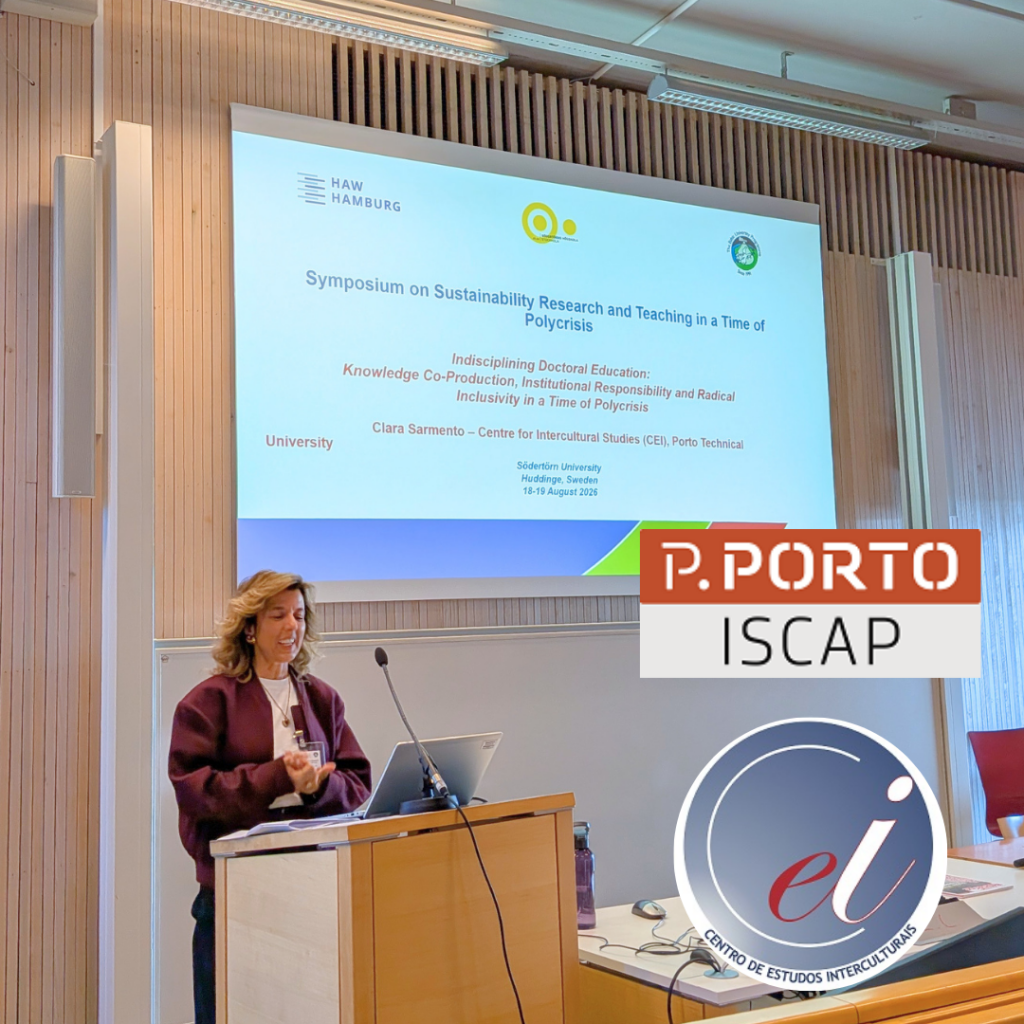
Clara Sarmento, Director of the Centre for Intercultural Studies (CEI) of ISCAP-P.PORTO, was invited to deliver a plenary lecture at the Symposium on Sustainability Research and Teaching in a Time of Polycrisis, held at Södertörn University, Huddinge, Sweden, on 18–19 August 2026. The symposium brought together researchers, educators, policymakers and practitioners to address the challenges posed by the convergence of climate change, biodiversity loss, geopolitical instability, economic inequality and social disruption, and to explore more transdisciplinary approaches to sustainability research and education.
Entitled “Indisciplining Doctoral Education: Knowledge Co-Production, Institutional Responsibility and Radical Inclusivity in a Time of Polycrisis,” the plenary addressed the urgent need to rethink how doctoral education responds to a rapidly changing and increasingly interconnected world. The presentation examined how universities can move beyond disciplinary silos and conventional hierarchies of knowledge in order to strengthen their capacity to contribute to sustainability transitions and to engage meaningfully with societies facing complex and systemic crises.
The concept of “indisciplining” doctoral education was presented as a way of challenging established boundaries between theory and practice, university and society, research and policy, and different systems of knowledge. By foregrounding epistemic pluralism, community-based research and reflexive institutional critique, the approach seeks to contribute to more inclusive and socially relevant models of doctoral education while strengthening universities’ capacity to support resilience, adaptation and meaningful social impact.
These arguments closely aligned with the broader rationale of the symposium, which emphasised the need for urgent, transdisciplinary responses to polycrisis, greater integration across disciplines and stronger connections between research, policy and practice. The event also sought to explore innovative approaches to sustainability education and research methodologies capable of addressing complexity while translating knowledge into real-world impact.